
Once you have a chess club at your school or library and your students are having fun and improving academic and life skills by playing chess, you can use chess to help teach academic subjects like literacy.
While playing chess, children learn to analyze game situations and consider the potential consequences of different moves. This is analogous to analyzing a story where one would consider the potential actions of characters and anticipate various conclusions.
Several educators have successfully leveraged chess in teaching literacy and shared their results and the resources they developed.
Dr. Alexey W. Root is a senior lecturer at the University of Texas at Dallas where she teaches education classes and prepares students to become teachers. She received her doctorate in education from UCLA and taught high school social studies and English. She is also the Chief Science Officer of Chessable, a Woman International Master, and the 1989 U.S. Women’s Chess Champion. She currently teaches courses that explore the uses of chess in classrooms.
In Read, Write, Checkmate: Enrich Literacy with Chess Activities, she shows teachers how to use chess to help students in grades three through eight with literacy. She explains how to meet educational objectives while teaching chess to students and how to have kids read and write about chess while learning to play. The final chapter explains how chess can be used in libraries. All activities are linked to NCTE/IRA national standards for language arts. Her other books include: Children and Chess: A Guide for Educators, Thinking with Chess: Teaching Children Ages 5-14, and Science, Math, Checkmate: 32 Chess Activities for Inquiry and Problem Solving.

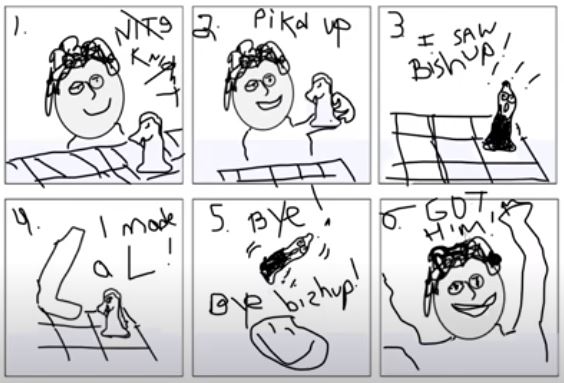
Victoria Winifred is a retired school teacher from New York and Tennessee. She received her MS in Education from Hofstra University and recently published The Princess, the Knight, and the Lost God: a Chess Story. In the 10-minute video Using Chess to Promote Literacy in Preschoolers, which she presented in the 2023 London Chess Conference, she explains how to use chess to teach vocabulary, to prepare students for school expectations, and to plant seeds to grow a love of reading and writing. She shows this example of a child beginning to use words while retelling a chess experience in the correct order:
In See how writing is like a great game of chess, Anupam Chugh explains how, as a writer and a chess player, he sees a game of chess in every story.
In Chess and Literacy, Neil Dietsch and Jerry Nash explain how to use chess to teach key literacy proficiencies: visual orientation, symbolic language, translation from two-dimensional to three-dimensional, and pattern recognition.
You can also use chess-related story books like these to teach literacy to young chess fans:
- Alex and the Wednesday Chess Club by Janet Wong
- How to Survive a Totally Boring Summer by Alice Delacroix and illustrated by Cynthia Fisher
- Someday I’ll Be a Queen: A Pawn’s Journey Across the Chessboard by Christel Minne
- Freddie Loses His Game by Dorian Clay
- Across the Battlefield: a Pawn’s Journey by Jonathan Ferry and illustrated by Caroline Zina
- My Name is Tani … and I Believe in Miracles by Tanitoluwa Adewumi
- The Queen of Katwe: One Girl’s Triumphant Path to Becoming a Chess Champion by Tim Crothers
Now with these resources, you can start leveraging chess in your English and Language Arts classes!
Please share your experiences using chess to teach, and I will update this article with your insights.

 Indermaur Chess Foundation