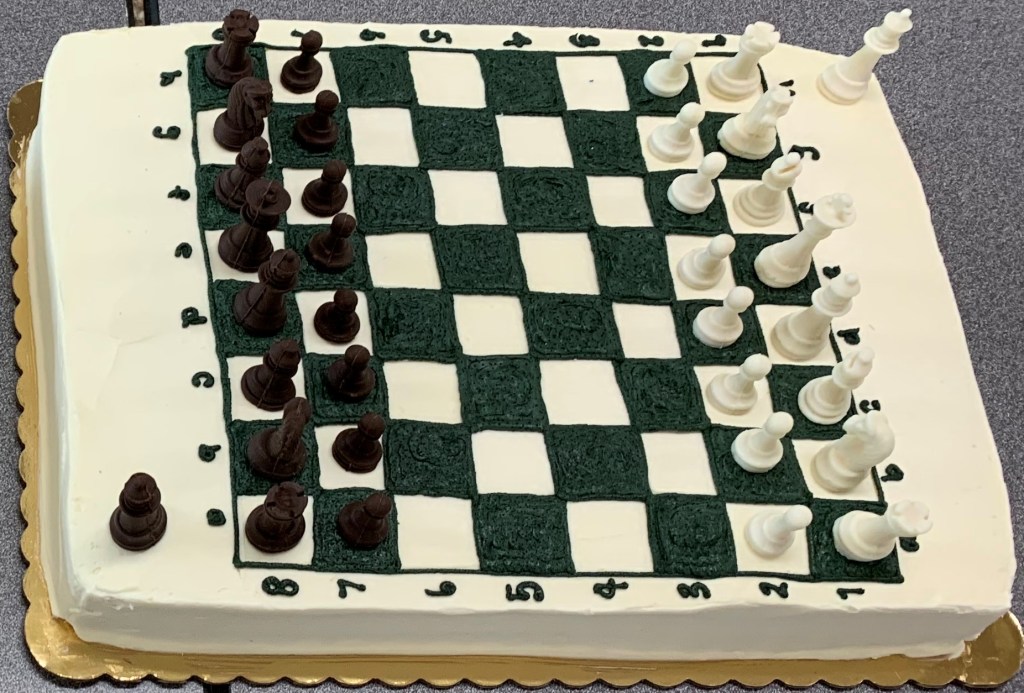
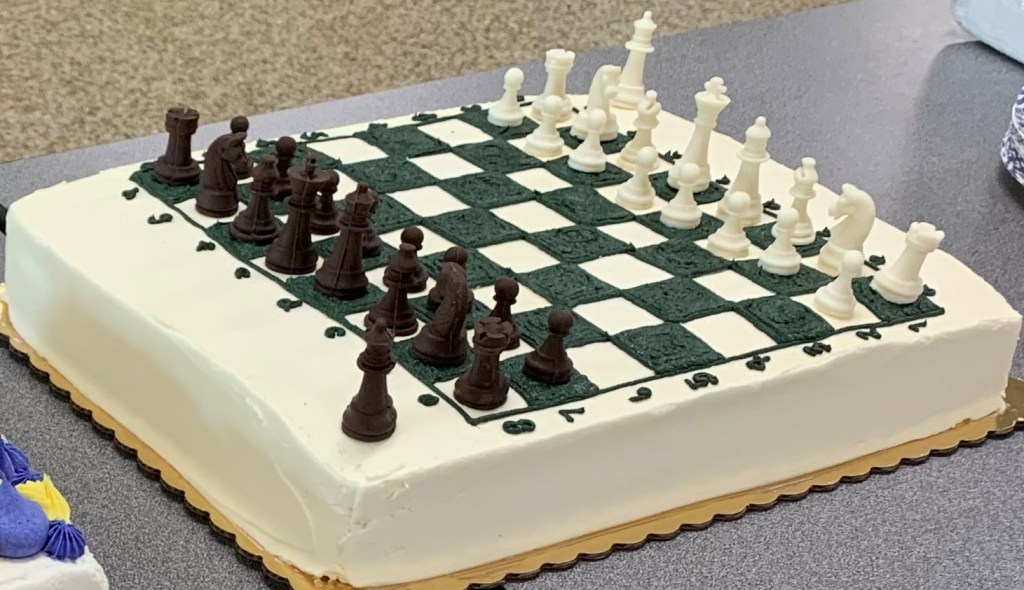
The Hunter Elementary School chess club in Raleigh made this fun chess cake to celebrate another great year! Here’s how you can make one, too:
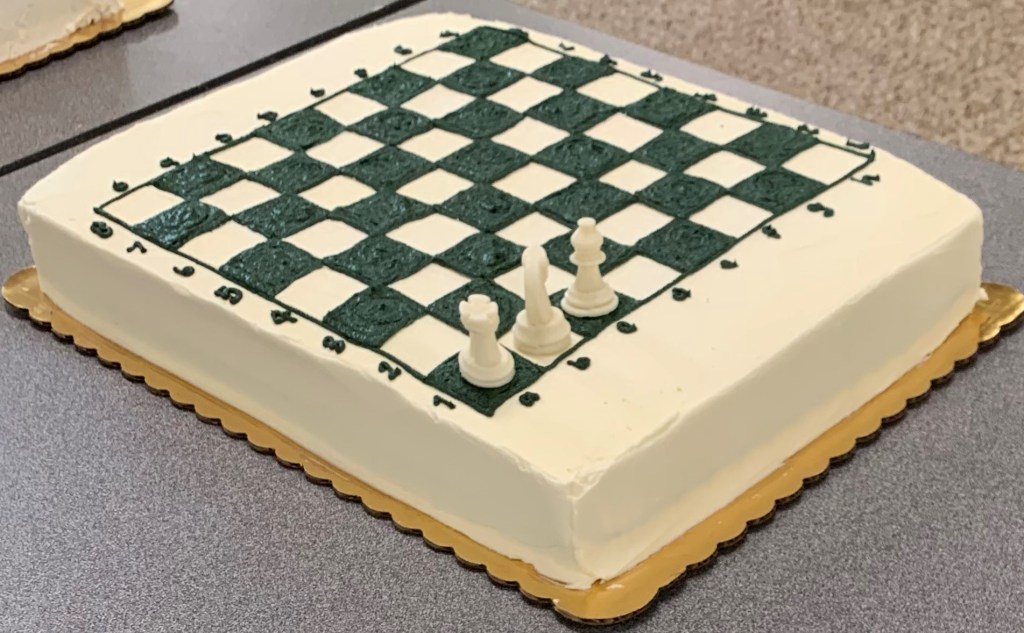
One of the chess club parents ordered the cake itself from the Whole Foods Market bakery. She emailed the bakery a photo of one of the club’s chessboards so that the bakery could create a realistic chess board out of icing. The cake was delicious and reasonably priced.
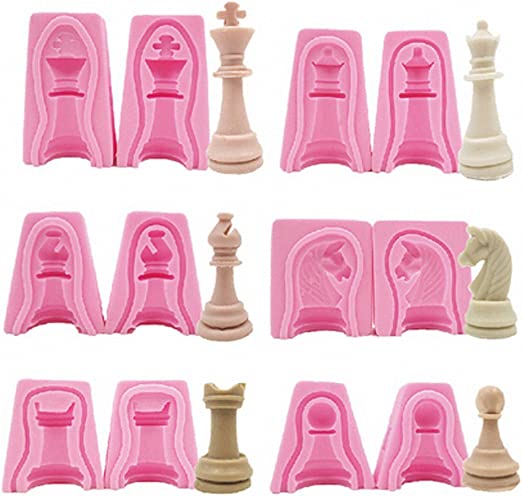
After researching several options including ordering pre-made chocolate chess pieces from Etsy, the parent decided to buy molds to make the chess pieces herself. She selected MoldFun 3D chess piece silicone molds from Amazon.
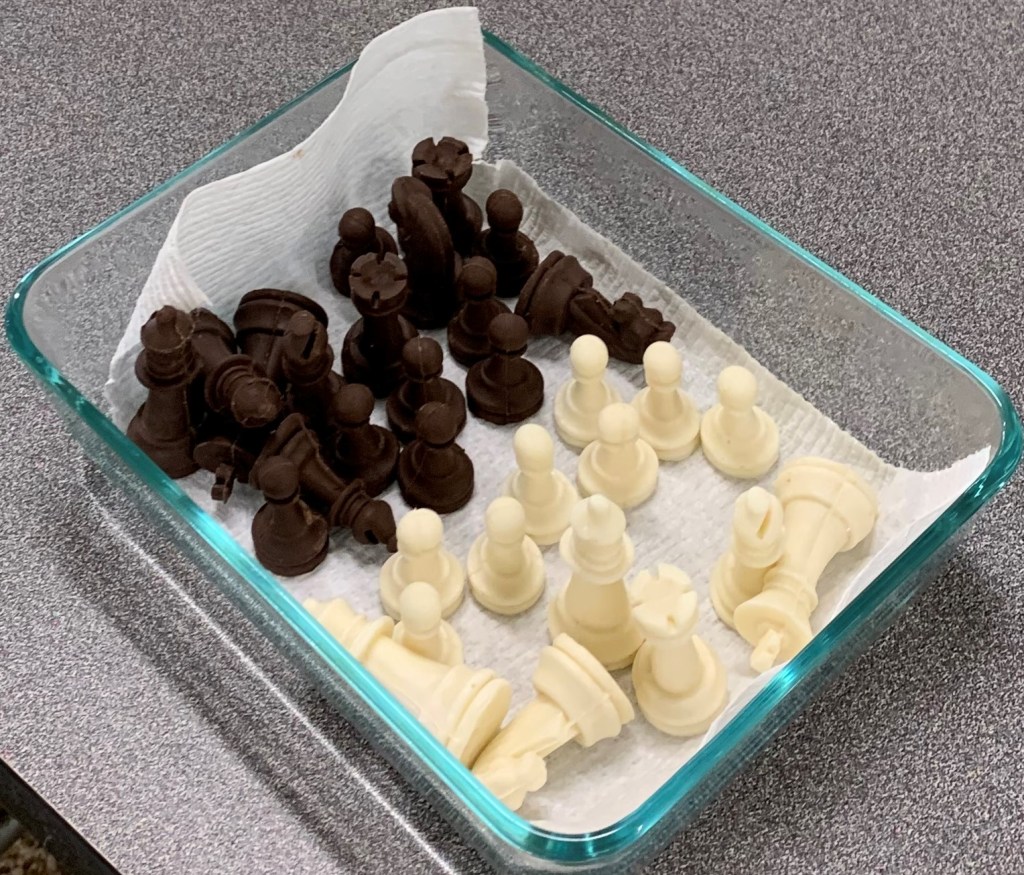
She bought 10 ounces each of Ghirardelli dark and white chocolate melting wafers for the molds from Target.
The chocolate chess pieces looked great and were delicious!
She waited to place the pieces on the cake at school so there was no risk of them falling over in transit.
We did have a second, traditionally-decorated cake for students who have allergies or dietary restrictions. Next year, we can buy vegan chocolate to make vegan chess pieces, too.
One final recommendation if you have a large chess club is to use the sharpest knife possible to cut the cake. This makes it easier to cut a large number of pieces.
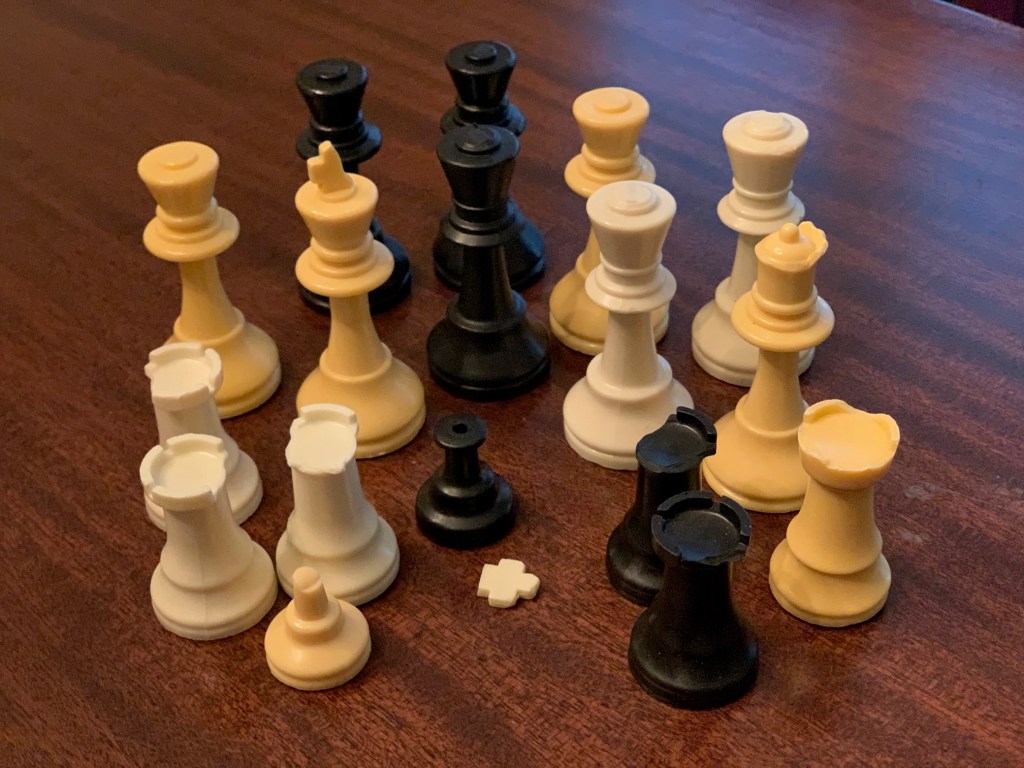
If your chess club plays in a room like a school cafeteria that has a hard floor, then, over time, you may have several broken pieces to replace. You could always buy an entire new set of pieces from a chess supplier like WholesaleChess.com or US Chess Federation Sales, but kings and rooks seem to be more fragile than other pieces, so you probably need to replace more of them.
I recommend ChessHouse.com for replacement pieces, because they sell individual solid plastic pieces at reasonable prices and with good service. They give you a bulk discount if you buy 100 of any combination of pieces, have coupons that give you an additional $5 off orders of $25 or more, and offer free shipping if your order is large enough.
Congratulations on joining US Chess! Once you or your child plays in a US Chess rated tournament, you will earn an official US chess rating.
I will explain how to look up your US Chess member ID number and your rating using 2022 US Women’s Chess Champion, Jennifer Yu as an example.
On uschess.org, hover over “Ratings” and then click on “Player/Ratings Look-up”. Then enter your name in the search field. For our example, I entered “Jennifer Yu” and received this result which includes the member ID numbers for each member whose name matched my search criteria:
If you have a common name, you could narrow the search by selecting your state first or by including your middle name (if you provided that in your US Chess profile).
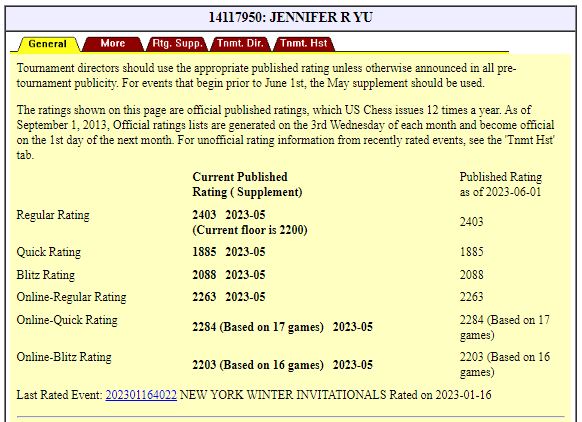
Then click on your line in the results list to display your USCF summary page. Clicking on the Jennifer Yu from Virginia will display this page:
The summary page shows a player’s current monthly supplement ratings for each of the six types of US Chess ratings (Regular, Quick, Blitz, Online Regular, Online Quick, and Online Blitz). These are the same ratings as are shown on the search result above.
These official supplement ratings are only updated once a month on the 3rd Wednesday of each month and become official on the 1st day of the next month.
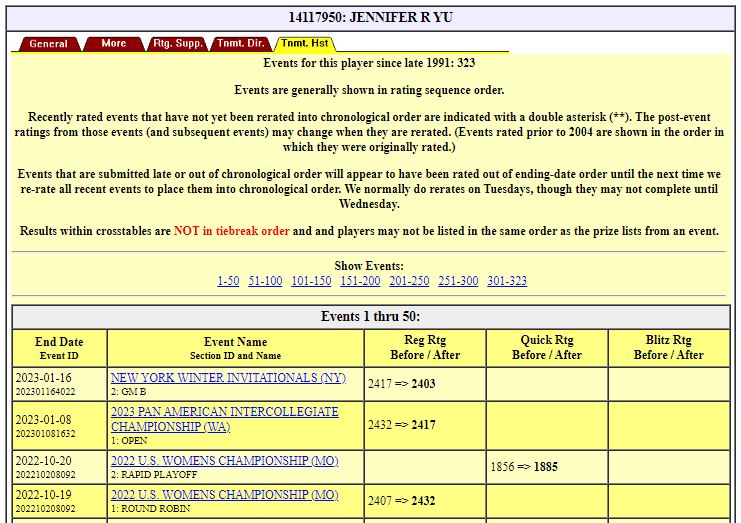
To see your most recent rating, click on the “Tnmt. Hst” or Tournament History tab. This will display all the tournaments you have played in with the most recent tournament at the top. For each event, it will show your rating before and after the event, so your current rating is the one after your most recent event.
If one of your recent event has a double asterisk (**) beside it, that means that it has not yet been rerated into chronological order, so your rating from this event is subject to change.
If you click on one of the events in your tournament history, you can see the rating report for that event. Please see my earlier article, “Reading a US Chess Rating Report,” to learn how to interpret these reports.
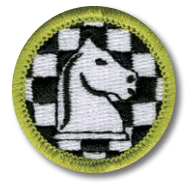
Since many of your middle and high school chess club members may also be members of Scouting America, helping them earn the chess merit badge would be a great way to combine two of their favorite activities.
All of the requirements for the chess merit badge (which are described in the chess merit badge pamphlet) are topics you would naturally cover in chess club meetings, so it would be easy to help your club members earn this extra recognition.
You can also leverage additional online resources like the following:
ChessKid chess merit badge guide: This series of ten articles is designed for scout leaders and parents who want to help scouts achieve the merit badge and enjoy the game of chess. They were written by Jerry Nash, a national chess education consultant who served on the committee which developed the content for the chess merit badge pamphlet.
St. Louis Chess Club online chess merit badge camp: This free, online camp is held several times a year. The St. Louis Chess Club has been holding chess merit badge workshops since the chess merit badge was introduced in 2011. When Scouting expanded in 2019 to allow girls to join, the St. Louis Chess club was also the the first to offer a workshop specifically for girls.
If you would like, you could also become an official merit badge counselor for the chess merit badge by contacting your local Scouting council and completing the steps described in the Guide to Merit Badge Counseling.
We are partnering with ChessKid.com* to give 100 schools in North Carolina free ChessKid Gold accounts for all their students in the 2023-2024 school year.
Since we have 100 counties in NC, our goal is to have a school in each county receive one of these grants. This will help tens of thousands of children learn how to play chess and bring the benefits of chess clubs to every corner of our state.
For more information and to apply for one of these grants, please read this ChessKid article. The application deadline is June 30, 2023 or until 100 schools are selected.
* ChessKid.com is the scholastic extension of Chess.com – the #1 online chess site. ChessKid is dedicated to being a safe place for kids to learn and play chess. ChessKid introduces kids at an early age to the game of chess, teaching them how to play while having fun. It is an educational tool that teachers can use in their classrooms to help students develop critical thinking skills.
Inspirational chess movies are a great way to motivate your students for big upcoming chess events like the Triangle, NC, and National Championships!
Your young chess enthusiast may enjoy watching one of these inspiring chess movies about children that are all based on true stories: Searching for Bobby Fischer, Knights of the South Bronx, Brooklyn Castle, and Queen of Katwe. The first three movies also show state and national championship tournaments which would help prepare your child for the NC Championship. I have included links to the Wikipedia descriptions of each of the movies. Reviews and trailers are available online, so you can decide which might be best for your child.
A fun fact about Searching for Bobby Fischer is that Josh Waitzkin, the child prodigy in the movie, played Mike Klein (who many children know as FunMasterMike on ChessKid) in the tournament featured at the end of the movie.
The inspiring film, Her Move Next, shows how New York’s PS 33 Chelsea Prep elementary school empowers girls through competitive chess. It is a free, short film (about 18 minutes long). I highly recommend it!
Queen to Play, a French movie (with English subtitles), would also be good for older children (especially girls) or adults who would like a foreign language film.
Magnus, a Norwegian documentary (in Norwegian and English), chronicles Magnus Carlsen’s childhood as he becomes a grandmaster at 13 and world champion at 22.
Recommended by a chess club family, The Chess Players, an Indian movie in Hindi and Urdu (with English subtitles), would be good for older children or adults interested in Indian history.
We are excited to help sponsor the 2023 NC K-12 Championship! As of February 4, 570 students are registered including 71 first-time tournament players.
We will provide ChessKid Gold subscriptions to the top 5 winners and the top 3 females in all five elementary school sections (K-1, K-2, K-3, K-4, and K-5) – a total of 40 Gold subscriptions. We are also providing scholarships so more students can participate and have reserved a team room where schools we support can relax between rounds.
Our Aditya Nicholas Dias Memorial Fund is helping to fund the stipends for the K-12, K-8, and K-5 Champions to travel to the 2023 Denker, Barber, and Rockefeller National Tournaments in Grand Rapids, Michigan.
Aditya Nicholas Dias (September 8, 2004 to December 16, 2022) was an avid and very talented chess player who started playing chess at the young age of 5 years. He participated in many local, state, and national tournaments, winning several of them. Aditya also enjoyed teaching friends and classmates how to play chess. To honor his passion for chess, his family has established this memorial fund to support scholastic chess in North Carolina.
In the fall of 2022, US Chess launched a new Chess in Education committee and program to provide resources to teachers, schools, districts, and state boards of education so they can leverage chess as an educational tool.
I was invited to join this committee, and one of our first steps was to compile and publish a list of Grants and Awards for Chess Educators and a list of free Resources for Chess Educators on the US Chess website. Please review these resources and give me your feedback.
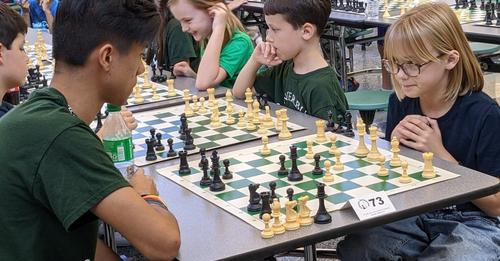
If your child or your chess club is playing in their first tournament, especially if it is a large one like the Triangle Championship or the NC K-12 Championship, then you may have some questions. Here are answers to the ones I have heard asked most frequently:
What should my child do the night and morning before the tournament?
Children should eat a good dinner and get a very good night’s sleep. Avoid scary movies, arguments, and negative conversations the night and morning before the competition. Please postpone sleepovers until after the event. Being well-rested will help children play with more concentration and focus. They will also have more energy in the later rounds. Solving puzzles on ChessKid or reviewing chess topics they have already learned is okay but trying to learn new material in the hours before a tournament is generally not helpful.
What should we bring to the tournament?
Have your child wear their school or clubt-shirt, because it will be fun for them and will make it easier for you to see them.
notation book, pencils (if your child knows how to take notation)
chess clock (if you have one, write your name on it and bring a spare battery. Set it for the tournament time control ahead of time)
sweater or sweatshirt (in case it gets cold in the tournament room)
portable chair (if your child is in K-1, you may want to sit outside of the K-1 tournament room)
snacks, drinks
any medication your child may need
chess set, book, game, or tablet and charger (in case your child finishes a round earlier, write your name on the chess board and bag)
phone or camera (share photos afterwards with your club, PTA, etc.)
When and where should we arrive?
Try to arrive early so you have time to meet with your team and help your child find their board for the first round. If you are registering onsite, try to arrive even earlier. If you have registered and paid in advance, then large tournaments typically do not require you to sign-in while small ones might (please check this in advance).
Confirm in advance if your team will meet in a team room or the “skittles room.”
The NC K-12 Championship usually allows teams to rent team rooms. For the February 10-12, 2023 event in the Raleigh Convention Center, the Indermaur Chess Foundation has reserved rooms 302a and 302bfor the schools we support.
Other events like the Triangle Championship have a “skittles room” or waiting area. For the January 15, 2023 event, this will be rooms 301a and 301b in the Raleigh Convention Center.
Who from our school is registered? Can another parent watch my child if I cannot stay the whole time?
Large events usually provide lists of players who are already registered, so you can arrange carpools, child supervision, etc. Here are links to the registration lists for the 2023 Triangle Championship and the 2023 NC K-12 Championship.
Can I still register my child? Can parents play, too?
Most events allow late and even on-site registration (although usually at a higher fee than if you had registered early). Some events like the Triangle Championship have Adult or Family sections.
Where can I find my child’s US Chess membership number?
How will I know who my child will play and where they should sit?
The tournament director will post new “pairings” on a physical bulletin board before each round. Many events now also post these online. The pairings are typically in alphabetical order by last name. Find your child’s name, what color they will be playing, and on what board they will be playing. Tips: take a photo of your child’s pairing and, once they are seated, make sure your child is seated across from the correct opponent, as the other child might be at the wrong board.
How are pairings generated?
Large chess tournaments use “Swiss System” pairing. Players are initially ranked and grouped by their ratings. Swiss pairings split each group into two halves and pair the top of the first half with the top of the second half. For example, if, after two rounds, there are 16 players with 2.0 scores, #1 will play #9, #2 will play #10, etc. If there are 4 players with 1.5 scores, #1 will play #3, and #2 will play #4. This process repeats to cover all groups of players. This Wikipedia article that explains this in more detail including exceptions and special situations like accelerated pairing.
Why does my child have to play such a highly rated player?
The pairings for the first round or two in big tournaments typically have the largest disparity in ratings. After that the games are much more evenly matched. Most children will get to play some opponents who are rated higher than they are. They may also play some who are rated lower or are un-rated. Please encourage your child to focus on their game – not their opponent’s rating. If they play someone un-rated or with a low rating, the opponent could be a strong player who is new to tournament play. They should not let their guard down but instead focus on playing their best. When children play higher-rated opponents, they should stay focused, play thoughtfully, and look for any mistakes their opponent may make (as their opponent may let their guard down).
How many rounds will my child play? Could they get eliminated?
Every child gets to play every round. No one is eliminated. That is one of the advantages of Swiss System pairing.
What should I do if my child needs to miss a game?
Please request a bye for the round that your child will miss. You can do this via the tournament website. If you request this in advance, your child will receive 0.5 points for that round. It also prevents another student from being paired with your child that round and sitting at the board waiting for your child.
How are tournaments scored?
Players earn 1 point for a win, 0.5 points for a draw, and 0 points for a loss. In big tournaments, your child will need to walk with their opponent to a scorer’s table and report their score together. Your child’s tournament score is the total of the points they earned from each of their games. Team scores are usually the total of the top 4 individual scores.
How are ties broken?
Ties are broken using formulas based on your opponents’ success in the tournament. For example, if you are tied with someone for first place and your opponents did better than theirs in the tournament, then you would receive the first place trophy. There is also a good Wikipedia article describing these tie break calculations.
How many trophies and medals are awarded?
Large tournaments like the Triangle and NC Championships typically present over 100 awards for all ability levels. Students will be able to win individual and team awards.
Review your games and those of potential opponents. Ask yourself questions like, “Why did I do this? What was their plan?” and try to answer them. Try to remember what you were thinking during the game. You can also replay your ChessKid games by clicking “Play,” selecting “Game History,” clicking on the result for a specific game, and then clicking on the magnifying glass icon to step through that game.
We absolutely agree with US Chess that “chess is transformative for children by improving their focus, aiding in decision making, and teaching that choices have consequences — lifelong skills that can be immediately applied in the classroom,” so we are excited that they are continuing their Outreach Program for At-Risk Youth.
At the Indermaur Chess Foundation, we partner with NC schools to offer these and other benefits of chess to all students, especially those at risk, through our Game Changer Program. We provide each school accepted into our program with 5 chess sets, Chess Step instructional materials, ChessKid.com subscriptions, and online support.
When US Chess announced their outreach program in 2021, we applied on behalf of Wiley Magnet Elementary School and helped them start their chess club. Now in their second year, Wiley’s club used the free memberships provided by US Chess to enter a team in their first US Chess-rated tournament. You can tell from the photos they shared in their PTA newsletter that they had fun and gained good experience!
US Chess recently opened their 2022-2023 Outreach Program for At-Risk Youth supporting affiliates who offer chess at Title I schools, providing each school with 16 free youth memberships and 8 additional chess sets. We’re excited to announce that we applied and were accepted into the new program on behalf of Vance County Middle School and Graham High School!
“We are so appreciative of all you have done, and we look forward to working with the Indermaur Chess Foundation to expose our students to this awesome game/experience. Our chess club will meet three days a week after school, and we plan to incorporate it into our AVID college readiness program,” explained Dwaynna Ramsay-Morgan, Vance County Middle School teacher and chess club leader.
“You’ll be happy to know that student interest is high, and the club is very lively. I’ve been reading the book that you sent with the sets to become a better trainer myself. I very much look forward to the opportunity to send students to tournaments,” said Nikola Filajdic, Graham High School teacher and chess club leader.
If you’re interested in starting a chess club at your NC school, consider applying to our Game Changer Program! Let us know if you’re a Title I school so we can also apply for the US Chess program on your behalf.







 Indermaur Chess Foundation