Empowering Visually Impaired Players Through Chess: Discover Specialized Chess Sets and Resources

“It was magical!”

That’s how the teacher described the day her visually impaired student first played with the special chess set we provided. “She was so excited to play, and the kids loved playing with her.”

This teacher had started a chess club at Oberlin Magnet Middle School using one of our grants. Since her school is one of five in the Wake County Public School System which provides specialized programs and services for visually impaired students, she asked how she could help these students join her club.

We purchased a special wooden chess set from Chess House which has several features for blind or visually impaired players. The different color squares are raised or recessed so they can be identified by touch. All the pieces have pegs on the bottom to fit in the holes in each square; this keeps pieces steady and in the center of their square. The black pieces have pegs on the top to differentiate them from the white pieces.
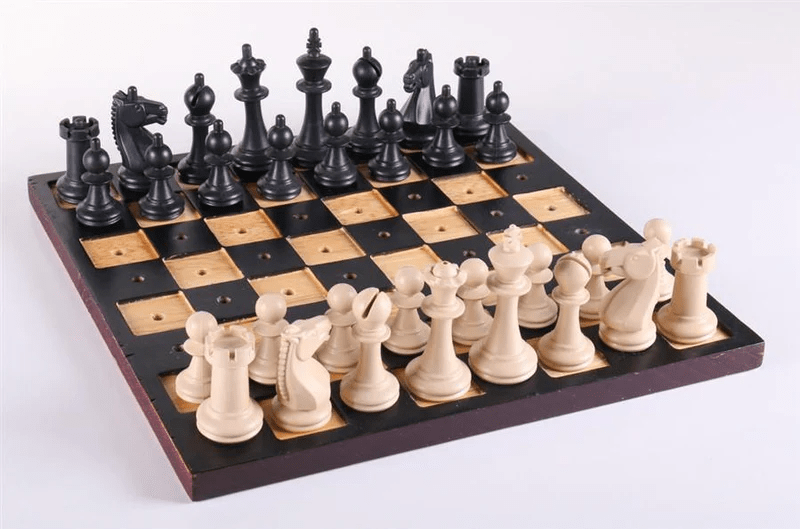
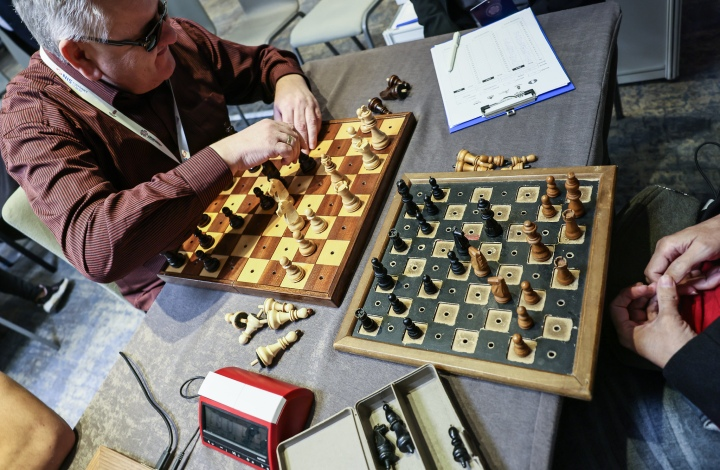
Specialized sets like this enable visually impaired players to play with each other and with sighted players. Several rules have accommodations for visually impaired players. For example, each player must announce their move and have it repeated back to them by their opponent. The touch move rule is adjusted to allow visually impaired players to touch any of the pieces or squares to understand the current position. Once they lift a piece out of its hole, the piece is considered “touched,” and they must move it (if they legally can).

The Braille Chess Association of the UK has a wonderful “how we play” explanation and accompanying video showing how visually impaired people play chess.
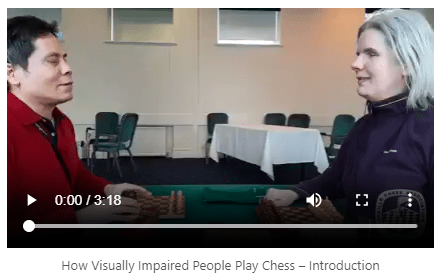
Playing chess has additional benefits for those with disabilities. “When I play chess, it’s as close as I’ve ever come to a sense of equality,” Jessica Lauser told CNN in “This woman is a chess champion. And she’s blind.” “When you start the game, no matter who you are, no matter what your physical condition is or where you come from or whether you have money, both sides start with the same thing.”

If your visually impaired children would also like to play chess online, you can use these instructions from the US Blind Chess Association to play on lichess.org with a screen reader. The International Braille Chess Association organizes regular online tournaments on lichess.org for visually impaired players. Both of these organizations provide lists of resources, and the USBCA also offers more than twenty braille chess books.

If you would like to organize a tournament which will include visually impaired players, US Chess maintains an excellent set of Guidelines for Accessible Chess Events. Rule 35F in the The US Chess Rule Book: the Official Rules of Chess describes the specific rules for visually impaired players, and “Opponents with disabilities need special care, so there are special rules to make it fair” answers common questions about these rules.
Ascribing to the US Chess core values,
we believe everyone has a seat at the chess table.

Elementary and Middle School Chess Club Tips

Would you like to start a chess club at your child’s elementary or middle school?

Many NC elementary and middle schools have started chess clubs with the help of our Game Changer program. Here are are some ideas from these clubs to help you start your own school chess club:

  • Have simple, fun goals: One club’s goals are to have fun, learn, and play lots of chess! Winning is intentionally not one of their goals, but as they pursue these three goals their children do win plenty of games and trophies.
  • Meet regularly: Most clubs meet weekly or every other week after school. Some meet before school, during lunch, or during a special “club period” (when all clubs meet).
  • Be inclusive: Most clubs are open to all ages and all ability levels. They invite beginners to join at the start of the year, so a parent or teacher and a few older students can teach them the basics. Students who already know how to play can join at any time during the year.
  • Play lots of chess! Every meeting children spend most of the time playing chess. Even children learning how to play can play mini-games with only a few pieces. Group the children by ability rather than age/grade so that their games are more fun and challenging and so that they learn more from them. Some clubs record the results of their games, so they can see if anyone is winning most of their games and needs to move up to a more challenging group. Try to avoid moving students down. Have a parent supervise each group of about 16 children. These parents do not need to know how to play chess.
  • Keep lessons brief and fun: Most clubs teach 10-15 minute lessons to their experienced players, so their students still have plenty of time to practice what they learn by playing chess. Many clubs have high school students teach; some use teachers, parents, or grandparents. Some clubs have middle school students teach with an adult helping to supervise the children. Most clubs use lessons from ChessKid or from the Chess Steps guide and workbook we provide.
  • Get PTA support: If your club is sponsored by the PTA, you can get some funding but more importantly a lot of support with volunteers, meeting space, publicity, etc.
  • Keep expenses low: Many clubs collect a small activity fee or ask for donations to buy more chess sets and eventually a few chess clocks. Most make their activity fee optional, for example collecting a $30 activity fee from those who are able to pay. While some families are not able to pay others contribute more. Most clubs deposit their funds with their PTA.
  • Save with US Chess membership vouchers: Some clubs buy every student one year US Chess memberships by buying discounted group membership vouchers.
  • Use ChessKid: Most clubs use the Basic ChessKid accounts that we provide with our Game Changer program. Some clubs buy discounted ChessKid Gold subscriptions through our program for all of their students, and some make them available to families who would like to buy them. Kids really enjoy ChessKid, and the ones who use it improve a lot.
  • Buy chess sets and supplies online: There are several good online chess suppliers.
  • Wear school or chess club t-shirts to tournaments: Most clubs wear school t-shirts or chess club t-shirts when they go to a tournament especially team tournaments. It is really helpful to have kids (and some parents) wearing the same shirt at large tournaments. Consider using the same t-shirt design for several years so families don’t have to buy new ones each year.
  • Share photos and congratulations: Some clubs share photos and congratulations using Twitter or Instagram. Others use a private Facebook group.
  • Use keychain chess pieces as prizes: A few clubs use colorful keychain chess pieces to reward effort, courage, and teamwork. For example, students can earn keychain pieces by teaching someone else how to play, playing in their first tournament, or doing 250 puzzles on ChessKid. Kids get really excited about these!
  • Give every child a chance to play in tournaments: Most clubs hold their own tournaments. Some use their club budget to pay the tournament fee at a local event for students whose families can’t afford it.
  • Publicize your success! All clubs share their tournament awards in school announcements and PTA emails and display their team trophies in the school trophy case. One club has a local trophy shop engrave every team member’s name on their team trophies.
  • Share your success with the local news: Cape Hatteras and Watauga school clubs had stories in their local newspapers. Wiley Elementary was on TV.
  • Consider using name tags for students to help parent volunteers learn their names. This is especially helpful for large chess clubs.
  • Watch an inspiring chess movie together: One club went as a group to see Queen of Katwe in a theater.
  • Invite a strong player for a simultaneous exhibition with some of your students. You could invite a strong player from the middle or high school where your students will go.
  • Organize a tournament at the end of the year: You could run a club tournament with all of your students in one section. If your club is larger, you could have separate sections for each grade.
  • Celebrate your success with an end of year party! Hand out trophies or certificates to the winners of your club tournament, recognize your graduating students, and enjoy some snacks. Hunter Elementary made a fun chess cake.

For more information, please see “Start an elementary school chess club.

Please add a comment with your suggestions or questions.

Good luck with your club!

Replacing broken chess pieces

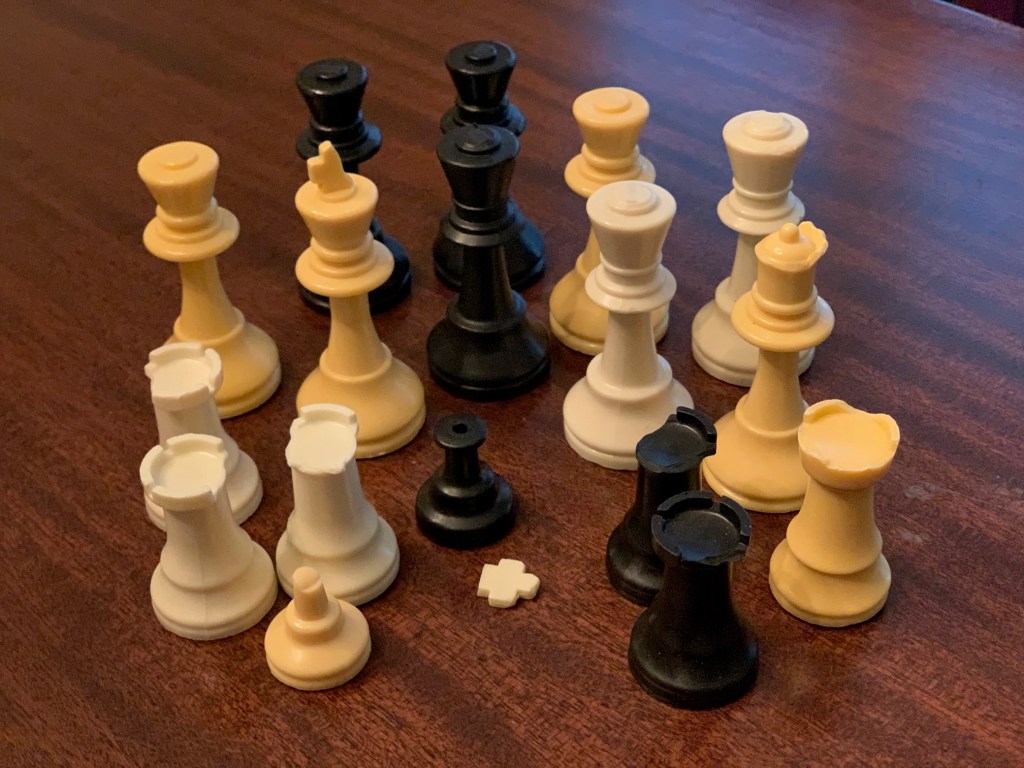
If your chess club plays in a room like a school cafeteria that has a hard floor, then, over time, you may have several broken pieces to replace. You could always buy an entire new set of pieces from a chess supplier like WholesaleChess.com or  US Chess Federation Sales, but kings and rooks seem to be more fragile than other pieces, so you probably need to replace more of them.

I recommend ChessHouse.com for replacement pieces, because they sell individual solid plastic pieces at reasonable prices and with good service. They give you a bulk discount if you buy 100 of any combination of pieces, have coupons that give you an additional $5 off orders of $25 or more, and offer free shipping if your order is large enough.

For more information, please see “Buying chess sets and equipment.”

Please leave a comment if you have found other good suppliers of replacement pieces.

Game Changer Program now provides chess sets to help NC schools start new chess clubs

We are excited to announce that the Indermaur Chess Foundation has enhanced the Game Changer Program to provide 5 chess sets along with instructional resources and support to each accepted school. Our goal is to help 100 North Carolina schools start new chess clubs!

NC public or charter schools starting new chess programs are eligible to apply. Accepted schools will receive:

  • 5 chess sets each with a 20-inch vinyl board and a set of chess pieces (We currently have colorful, weighted pieces. Please let us know your school colors so we can try to match them.)
  • Chess-Steps Learning Chess instructor manual
  • a Chess-Steps Learning Chess student workbook (and discounts on additional workbooks)
  • help setting up ChessKid accounts for their club
  • online support for their chess program coordinator
  • help arranging online or over-the-board matches with other schools in this Program

Now, it’s your move!

Apply now to bring the benefits of chess to your school.

If you would like to help more schools start chess clubs, please donate to support this Program.

Buying chess sets and equipment

Parents and teachers starting new clubs often ask me where to buy chess sets and equipment. There are many good chess suppliers online.

I buy chess sets, demo boards, chess books, score books, and key chain pieces (as incentives) from WholesaleChess.com. They provide good service, volume discounts, and free shipping if your order is large enough.

If you would like to see an item before buying it, large tournaments like the NC K-12 Chess Championship and the NC Open have chess stores onsite.

If your chess club has been using the same pieces for several years, you may have some broken kings or rooks (as they seem to break more easily than other pieces). You could buy a new set of pieces from any chess supplier. I also found that ChessHouse.com sells individual pieces at reasonable prices and with good service.They give you a discount if you buy 10, 50, or 100 pieces.

After you have bought enough chess sets for your club, you may want to buy some digital chess clocks to help students prepare for tournaments. I have bought DGT North American clocks from Amazon.

I have also bought a few items from US Chess Federation Sales. A friend of mine buys his club’s supplies from American Chess Equipment. If you are looking for a special chess set, House of Staunton has an excellent selection of beautiful sets.

What other suppliers do you recommend?