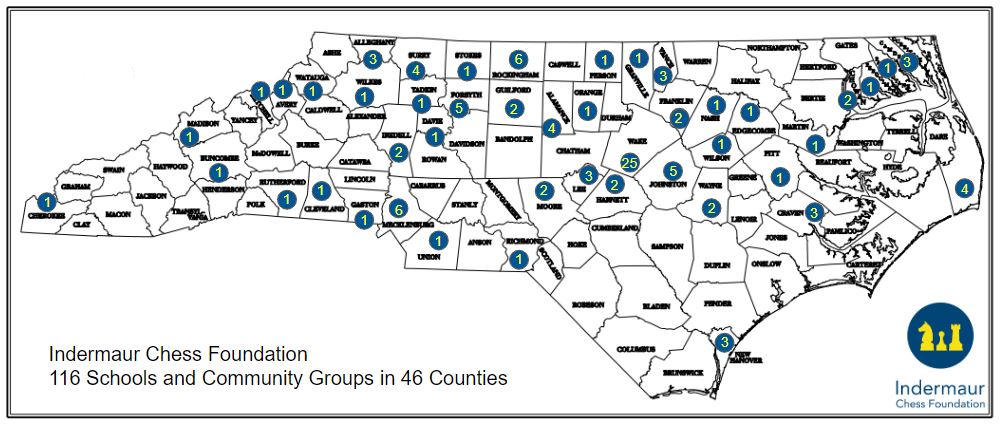
116 Chess Clubs across 46 NC Counties!

Thank you for your contributions and for telling schools and community organizations about our Game Changer Program, which provides grants of chess club starter kits and support!

Together, we have helped 116 schools and community organizations in 46 NC counties start chess clubs and experience the benefits of chess! Since we met the original goal we set in 2019 of helping 100 NC schools and community organizations start chess clubs, our new goal is to help these groups start a chess club in each of NC’s 100 counties.
We especially thank the contributors to our Aditya Nicholas Dias Memorial Fund. Aditya loved teaching his family, friends, classmates, and fellow scouts how to play chess. Your donations have enabled us to continue Aditya’s passionate efforts and spread his love for chess to 15 more schools, four senior centers, and two scout camps in the past year.

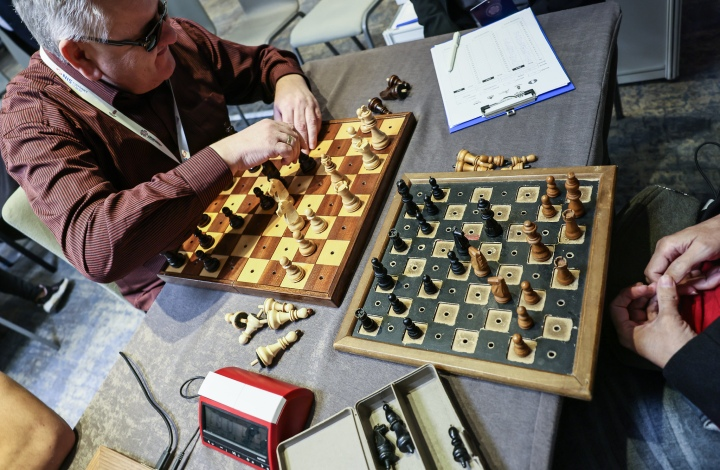
A visually impaired student wanted to join one of the new school clubs, so we provided them a special chess set and additional resources. It was magical! described the teacher as she shared the day her visually impaired student first played with her friends.

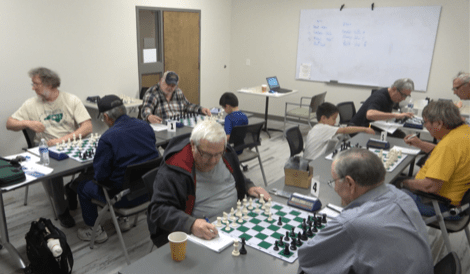
The senior centers are teaching chess classes, and two are holding tournaments. They tell us that the main reason their members want to learn chess is to play with their grandchildren.
The scout camps are teaching the chess merit badge, and one held weekly tournaments.
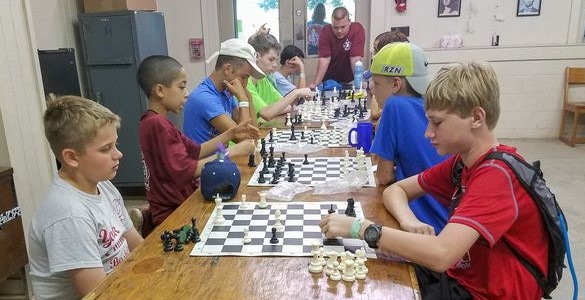
If you would like to start a chess club at your NC school, library, or community organization, please apply for one of our grants. This year we will continue to provide chess sets, instructor guides and workbooks, and ChessKid accounts to help organizations establish chess clubs, and will organize weekly ChessKid tournaments and other events to enable students from these clubs to play each other.

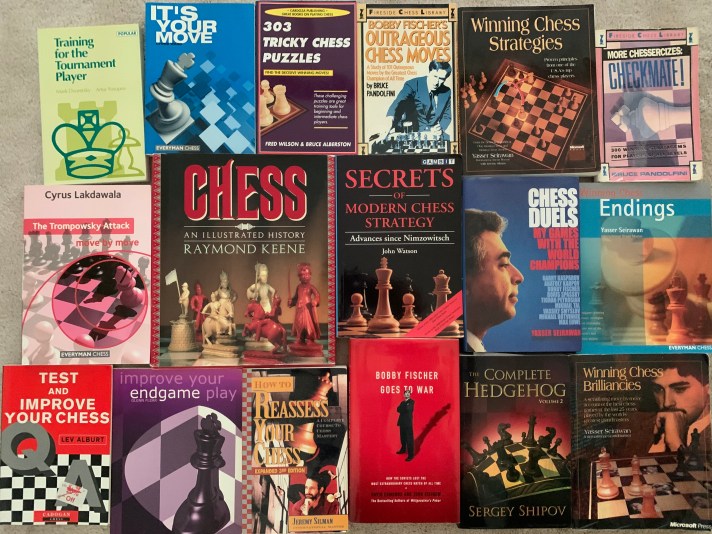
We have also received more donations of gently used chess books which we continue to provide to NC libraries with chess clubs.
Thank you, again, for your support!
Empowering Visually Impaired Players Through Chess: Discover Specialized Chess Sets and Resources

“It was magical!”

That’s how the teacher described the day her visually impaired student first played with the special chess set we provided. “She was so excited to play, and the kids loved playing with her.”

This teacher had started a chess club at Oberlin Magnet Middle School using one of our grants. Since her school is one of five in the Wake County Public School System which provides specialized programs and services for visually impaired students, she asked how she could help these students join her club.

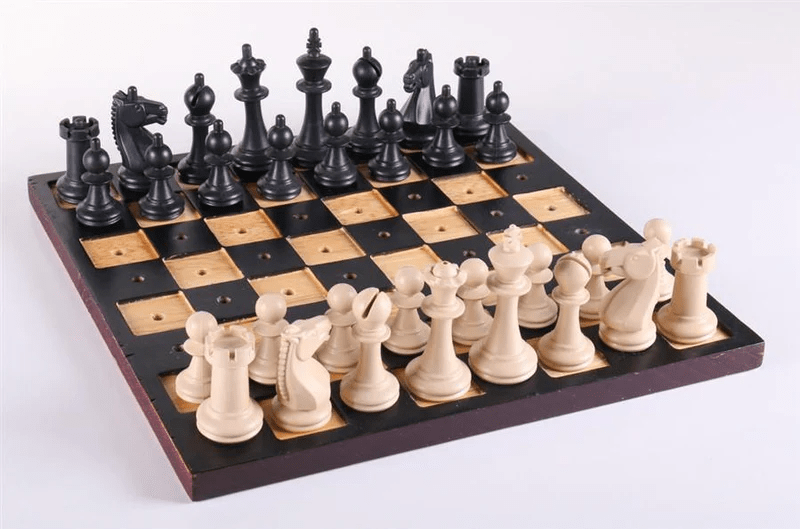
We purchased a special wooden chess set from Chess House which has several features for blind or visually impaired players. The different color squares are raised or recessed so they can be identified by touch. All the pieces have pegs on the bottom to fit in the holes in each square; this keeps pieces steady and in the center of their square. The black pieces have pegs on the top to differentiate them from the white pieces.

Specialized sets like this enable visually impaired players to play with each other and with sighted players. Several rules have accommodations for visually impaired players. For example, each player must announce their move and have it repeated back to them by their opponent. The touch move rule is adjusted to allow visually impaired players to touch any of the pieces or squares to understand the current position. Once they lift a piece out of its hole, the piece is considered “touched,” and they must move it (if they legally can).

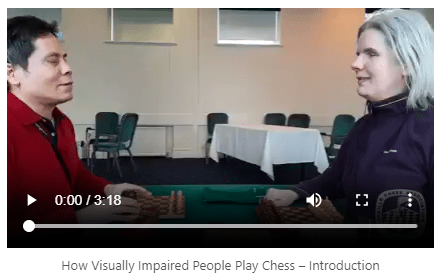
The Braille Chess Association of the UK has a wonderful “how we play” explanation and accompanying video showing how visually impaired people play chess.

Playing chess has additional benefits for those with disabilities. “When I play chess, it’s as close as I’ve ever come to a sense of equality,” Jessica Lauser told CNN in “This woman is a chess champion. And she’s blind.” “When you start the game, no matter who you are, no matter what your physical condition is or where you come from or whether you have money, both sides start with the same thing.”

If your visually impaired children would also like to play chess online, you can use these instructions from the US Blind Chess Association to play on lichess.org with a screen reader. The International Braille Chess Association organizes regular online tournaments on lichess.org for visually impaired players. Both of these organizations provide lists of resources, and the USBCA also offers more than twenty braille chess books.

If you would like to organize a tournament which will include visually impaired players, US Chess maintains an excellent set of Guidelines for Accessible Chess Events. Rule 35F in the The US Chess Rule Book: the Official Rules of Chess describes the specific rules for visually impaired players, and “Opponents with disabilities need special care, so there are special rules to make it fair” answers common questions about these rules.

Ascribing to the US Chess core values,
we believe everyone has a seat at the chess table.

Empowering NC Senior Centers: Launching Chess Clubs with Cognitive and Social Benefits

Did you know that August 21 is National Senior Citizens Day? Although we’re not quite ready to say goodbye to spring and usher in the dog days of summer, we’re already celebrating the chess achievements of older Americans who are enjoying the benefits of the game at some of our local senior centers. 

“Challenging the brain sustains the brain,” says Dr. Gerald M. Levitt. While we know that board games are good for cognitive stimulation, the health benefits of chess are in a league of their own. “Lifestyle Enrichment in Later Life and Its Association with Dementia Risk,” a 2023 article in JAMA, reports that “the cognitive stimulation from [playing chess] can increase resilience against brain pathologies by increasing the number of neurons, enhancing synaptic activity, and permitting higher efficiency in using brain networks.”

In fact, playing chess lowers the risk of dementia even more than reading does due to its trifecta combination of logical reasoning, critical thinking, and social interaction. And, according to the American Psychological Association, playing chess also decreases depression and anxiety in older adults. To that end, US Chess has partnered with Grouper, a Medicare Advantage benefit which may extend your membership to US Chess for a year for free. Read more here.

Northern Wake Senior Center (NWSC) in Wake Forest, the first senior center to apply for our Game Changer program, has leveraged our grant to start a chess club, offer classes, and even host tournaments. Brian, a member of the Center who has taught three beginner and one intermediate class so far, said that one of the main reasons his students want to learn the game is so they can play with their grandkids. Over the past year the Center has hosted six tournaments open to all ages. In March, 8 and 12-year old chess prodigies participated with the seniors, and April’s tournament found 22 folks taking up the challenge. Brian also said that the NWSC is currently considering hosting the 2025 NC Super Senior Tournament. 

If you’d like to start a chess club at your NC Senior Center or retirement community, consider applying for one of our grants