US Chess Safe Play: Creating positive, safe environments for players

Dan Lucas, the Senior Director of Strategic Communication for US Chess, interviewed me for the June 2024 edition of One Move at a Time.
On June 1, US Chess began requiring tournament directors to complete the core training from the U.S. Center for SafeSport, so one of the topics we discussed was the US Chess Safe Play Policy.

Unfortunately, children and vulnerable adults can be victims of bullying, harassment, and abuse in many different settings – including chess. I commend US Chess for aligning with other fields like sports, scouting, and education to provide positive, welcoming environments where misconduct is less likely to happen.

In 2017, after reports of abuse in gymnastics and other sports, Congress established the U.S. Center for SafeSport to develop and enforce policies, procedures, and training to prevent abuse and misconduct and gave it the authority to resolve abuse and misconduct reports for everyone involved in the U.S. Olympic and Paralympic Movement. More than 5 million people have completed SafeSport training.

Some of the insights that I learned from the training are:

  • those who try to harm children and vulnerable adults exploit trust and power
  • they seek organizations that do not have protective policies and training
  • they groom staff, volunteers, and parents in addition to potential victims
  • they message and email their victims privately to avoid detection

I am glad that US Chess selected a well-established training program like SafeSport for its Safe Play policy. As a coach for my kids’ soccer teams, I was required to take the SafeSport core course and annual refresher courses, so I already had a SafeSport account. It was easy to link it with US Chess.

I urge chess parents to read the free Parent and Guardian’s Handbook for Safer Sport and US Chess to make it available via the Safe Play Hub. This important handbook explains:

  • what makes for a healthy coach-athlete relationship
  • what policies and good practices you should look for in your child’s organization
  • what you should know about sexual abuse and sexual misconduct
  • what you should know about other forms of misconduct, including bullying, harassment, hazing and emotional and physical misconduct
  • tips for making sports situations safer for your child
  • how to talk to your child about misconduct
  • ways to encourage your child to speak up about misconduct if it occurs

The SafeSport training is very similar to the Youth Protection training which Scouting requires for all registered volunteers as part of its Safe Scouting program. The Parent and Guardian’s Handbook for Safer Sport is also similar to Scouting’s How to Protect Your Children from Child Abuse: A Parent’s Guide. One difference is that Scouting requires mandatory reporting of witnessed or suspected child abuse and of violations of its Youth Protection policies while US Chess requests reporting of alleged misconduct, mistreatment, or behavior that conflicts with the Safe Play policy. When some of my students asked for help earning the chess merit badge, I registered as a chess merit badge counselor and had to complete the required training. Registering as an adult volunteer with my local Scouting council currently costs $77 a year while the US Chess Safe Play training cost is only $19 for the first year and $9 in subsequent years.

The Safe Play policy is also consistent with policies in schools. For example, our local school system requires all volunteers to register and pass criminal history and sexual offender registry checks every year and to comply with specified school board policies. The Safe Play training is also consistent with the annual training we have for all employees and managers where I work.

Chess tournament directors and coaches are the “front line” for US Chess. With the SafeSport training, we are now better equipped to provide our players and their families with positive, welcoming environments where misconduct is less likely to happen.
Discover Adult Chess Clubs in NC | In-Person Chess Play

During the pandemic, many adults learned chess and started playing online, and then “The Queen’s Gambit” inspired even more. Naturally, these new players also wanted to play in person to experience the social, as well as the intellectual, stimulation of the game.

Many joined one of the clubs listed in the NC Chess Association’s club directory or one of the community clubs we support, but some wanted opportunities to play other adults at clubs like these:

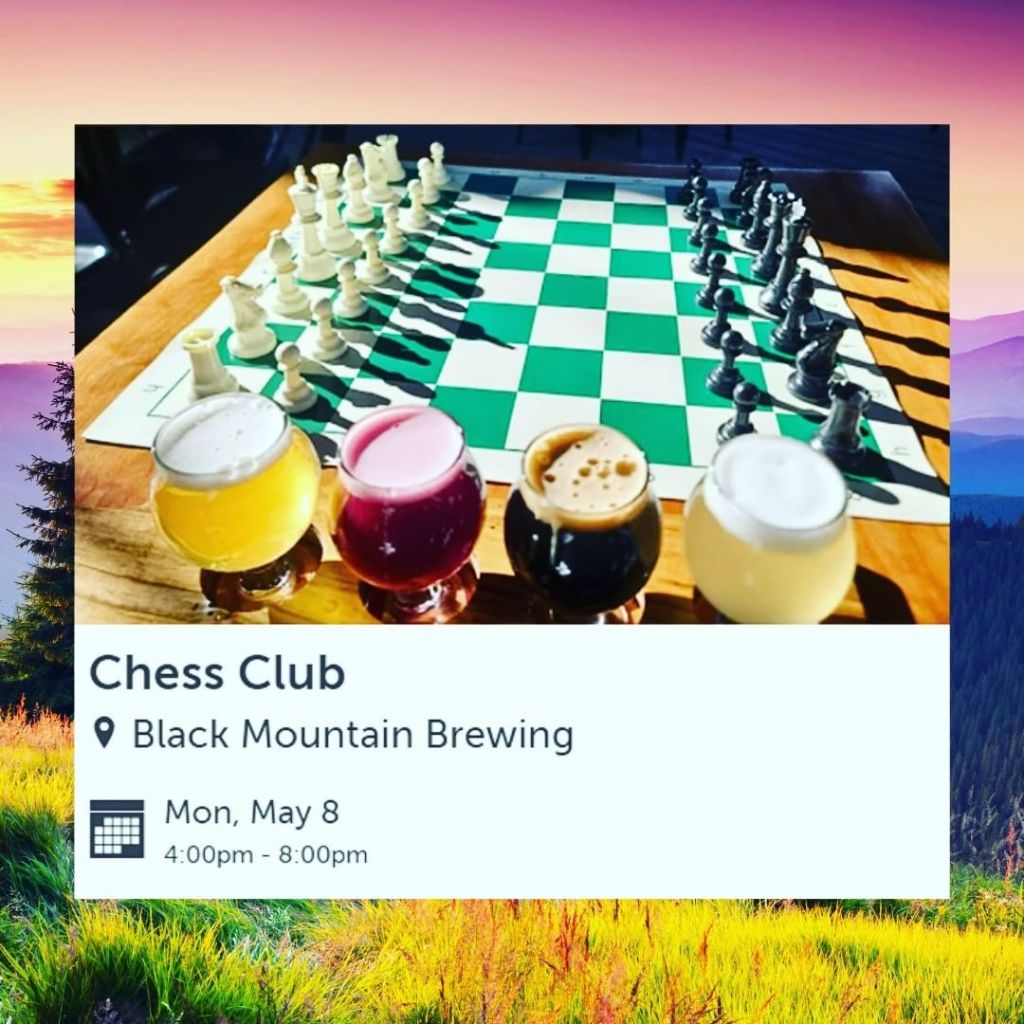
Black Mountain Brewing in Black Mountain – Monday nights starting at 4 pm

Noble Kava in Boone – chess Wednesdays 5-7 pm, game day Sundays 6-10 pm

Charlotte Chess Center – Adult Casual Play – Monday nights. The Charlotte Chess Center also offers a special adults-only At Least Twenty One (ALTO) tournament.

Sir Edmond Halley’s Restaurant & Freehouse in Charlotte – Tuesday nights 7-9 pm

Armored Cow Brewing in Charlotte – US Chess Social – March 15, 2025 4:30 – 10 pm

Eno House in Hillsborough – Thursdays 6:30 pm in the little building

Lanza’s Cafe in Carrboro – Wednesday’s 6-8 pm

Der Nachbar Bottleshop & Taps in Durham – Tuesday nights 5:30 – 8:30 pm

North Street Beer Station in Raleigh – Sundays at 2 pm, 12 chess boards available on site

If you would like to start a chess club for adults in your NC community, please apply for one of our grants for community organizations.

Please let us know about other NC chess clubs or programs for adults, and we’ll update this article.

Anyone – Even Adults – Can Learn This Game!

Can old dogs really learn new tricks?  If they’re a few ticks past middle age, like I am, there’s hope!  Over the years when my husband taught our children to play chess, I stayed in the background and didn’t get involved.  After all, I was a tired mom who was busy with other responsibilities and who had decided that it would be too challenging for me to learn such an intricate game.  We’ve all heard the stories about how chess is for brainiacs, right? By the time I’d birthed my sixth child, it was news to no one that I’d lost more than a smattering of brain cells. Give me Scrabble, Boggle, Bananagrams, or any other word game … but chess?  Nope.  That was not going to happen in this lifetime. I was too scared to give it a try. What if I couldn’t learn how the pieces move? I mean, this game has a knight, amirite? Forwards “L,” backwards “L,” right-side-up and upside-down “L” moves – what if I were even more spatially challenged than I thought? Patterns just aren’t my thing. (One time I tried to follow a pattern to sew a pair of shorts, and they fell apart in two panels the first time my daughter wore them). And don’t even get me started on castling, putting my opponent in check, or recognizing that I was the one in check!  I had completely talked myself out of ever being able to learn this game. I was content to smile politely and nod at the appropriate times when other chess parents were discussing their child’s chess moves. When they exclaimed with excitement, “Did you see little Jimmy whip out the Ruy Lopez in that game? Wow, what a great opening!” I, having no idea what they were saying, heard “Living La Vida Loca” start to play in my head. The Sicilian defense?  I was dreaming up delicious pasta dishes.  

Running an elementary chess club alongside my husband, Mark, didn’t require any special skills from me other than behaving like the mom that I am.  Kids are kids, and they need supervision, encouragement, and, on occasion, reining in.  I could perform all three duties with aplomb.  Even though I could set up a chess board at lightning speed and had learned to field questions about whether or not someone’s king was in check, I knew it was time for me to begin getting acquainted with this game.  I was inspired by the enthusiasm that five and six year olds had for learning how the pieces move, so I started doing puzzles on ChessKid and found them to be all sorts of fun.  Chess mom Beth C., who says she learned chess “by accident” when her daughter was new to chess club, agrees: “The children were encouraged to do lessons on ChessKid. At home, we used the lessons as a privilege that our daughter could have while eating dinner. Since electronics aren’t normally allowed at dinner, this served as a great motivator for her to do her ChessKid lessons.” Beth added that she got sucked in to those lessons and, before she knew it, ChessKid dinners had become a nightly ritual in her house. The enjoyment she experienced in learning the game surprised her, and she says she “certainly didn’t expect it to become such a source of bonding” with her daughter.  She had so much fun that she had to stop herself from logging into her daughter’s ChessKid account to do the lessons while her daughter wasn’t home! 

Beth went on to hone her new skills by teaching beginning chess to the youngest members of Hunter Elementary School’s Chess Club in Raleigh, NC. 

Crystal W. concurs, explaining that her chess playing youngster urged her to learn the game after his coach, Mark Indermaur, challenged the children in the chess club to teach their parents to play.  She also relied on ChessKid to learn how the pieces move and was soon sitting across the board from her son as his worthy opponent. Like Beth, Crystal found the most valuable part of learning the game the “added closeness” with her son. “When he wanted to test out new strategies, I was a willing victim. When he wanted to excitedly chatter about how a tournament game had gone, now I could follow along.” 

Whether you want to keep your brain sharp, or connect with others, or even if you just want something to do to pass the time, why not give chess a try? These resources can get you started.

Remember, anyone can learn this game – even adults!

Bringing Moms to the Boards

It’s no secret that chess moms deserve a medal; after all, they lend steady support to their kid’s chess-playing efforts in many ways, not the least of which is by logging weekend hours perched on uncomfortable chairs in hotel lobbies, school cafeterias, or chess centers while their future grandmasters hone their skills over the board. But on October 9th, 18 chess moms flipped the switch and played for trophies when they chose to showcase their own (mostly newly acquired) chess skills at the first ever “Chess Moms Play Chess, Too” tournament held at Hunter Elementary School in Raleigh, NC and organized by my husband, Mark, and me. Read more about our event in this article I wrote for US Chess: Chess Moms Play Chess, Too